Algirdas and Remigijus Gataveckas. Exhibition “The Code: I Am”
On August 27 at 6:00 p.m., the Meno niša gallery will host the opening of the solo exhibition The Code: I Am, featuring the work of artists Algirdas and Remigijus Gataveckas. Conceived as a unified installation, the exhibition explores the institution as a system that both protects and shapes individuals. Rooted in personal experience, the narrative raises the question of where institutional care ends and the restriction of individuality begins.
Algirdas and Remigijus Gataveckas (b. 1985) are Lithuanian artists working in painting, drawing, installation, and public art. They combine the tradition of academic realism with the principles of conceptual art. Social exclusion, identity, memory, and human dignity are key themes in their work. 2026 has been a particularly successful year for the artists. They were named laureates of the Baltic Awards for their significant contributions to art. Their work, Genealogical Deformation, was selected from 1,474 entries to be featured in the Herbert Smith Freehills Kramer Portrait Award 2026 exhibition at the National Portrait Gallery in London. Currently, the duo’s drawing You Are Already Looking At Me Longer Than My Parents Ever Did is on display at the Vilnius Picture Gallery’s exhibition In the Beginning Was the Line: Drawings from the 18th–21st Centuries from the Collections of the Lithuanian National Museum of Art. The Gataveckas’ work has also been presented outside of Lithuania. In 2023, their mural Independence was installed inside the Embassy of the Republic of Lithuania in Seoul. Their works are included in the collections of the MO Museum, the Autoportretas Gallery-Museum of Vidmantas Martikonis, and private collections in the U.S., Austria, and Estonia.
The Gataveckas brothers have a long-standing creative relationship with the Meno niša gallery. The gallery hosted their debut solo exhibition, Situation, in 2010 and presented Self-Portraits – Homonyms in 2015. In their latest exhibition, The Code: I Am, the artists’ perspective shifts, and the focus moves from the individual, which previously dominated their work, to the institution that shapes it.
In the context of the exhibition, the institution is not associated with any specific system. The artists perceive it more broadly as a structure that organizes people’s daily lives, establishes norms of behavior, creates mechanisms of order, and defines the individual’s place within the system. For the Gataveckas, it is important not only to consider the individual under the influence of the institution but also the logic behind its operation, including established rules, oversight, and the relationship between the individual and the surrounding structure. Thus, the artists’ personal experiences in the exhibition serve as a starting point for broader reflections on institutional functioning.
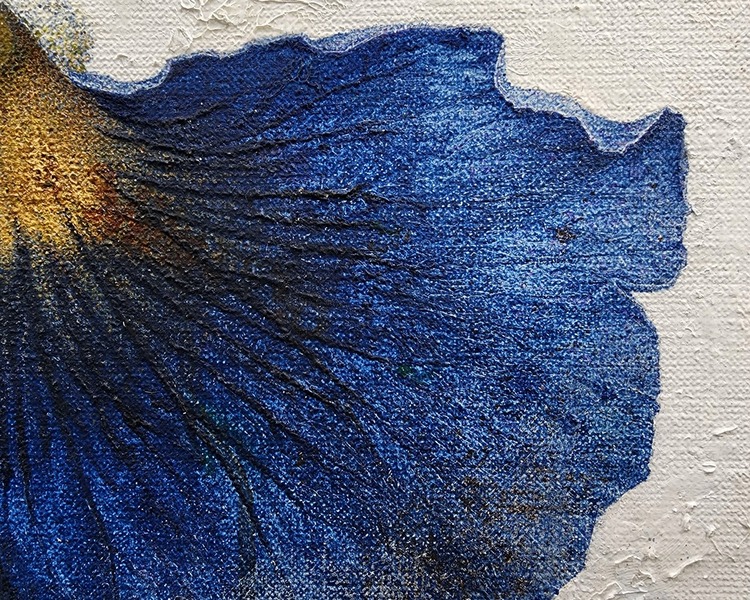
The transformation of the canvas lies at the heart of the exhibition, The Code: I Am. The canvas is removed from its stretcher, coated with lapis lazuli, folded, and tightly wrapped in transparent packing film. This irreversible act renders the painting’s previous state inaccessible and transforms it into an object. The plastic film has a dual meaning: while it is typically used to protect artwork, here it simultaneously compresses and constrains it. Lapis lazuli also occupies a special place in the installation. Once extremely valuable, it was associated with the sacred, nobility, and luxury. Today, its history is inextricably linked to resource exploitation and power struggles. The Gataveckas draw on the ambiguity of the material to address the creation and appropriation of human value.
In the exhibition, the Gataveckas refrain from offering a definitive assessment of the institution. Here, care is inseparable from control, protection from restriction, and conferring value is inseparable from the possibility of appropriating it. The artists do not attempt to reconcile these contradictions. Instead, they leave them open, allowing viewers to confront the contradictions in the institution’s operations themselves.
The exhibition runs through October 3.
The project is funded by the Lithuanian Council for Culture.
The gallery is sponsored by the Vilnius City Municipality.